
Does red light therapy help with inflammation? Yes, for the right kind of inflammation. Red and near-infrared light can calm localized, tissue-level inflammation, the swelling and irritation behind sore joints, strained muscles, and slow-healing injuries, and the human evidence is strongest for inflammatory joint conditions like knee osteoarthritis and rheumatoid arthritis. What it is not is a whole-body anti-inflammatory pill. There is little good evidence that shining light on healthy skin lowers systemic, body-wide inflammation, and it does not cure the underlying disease. Used on a specific painful area, several times a week, it is a low-risk way to take the edge off inflammatory pain.
Acute vs chronic inflammation: which one are we talking about?
Inflammation is not one thing. Acute inflammation is the helpful, short-term response to an injury or infection, redness, heat, swelling, and pain while your body repairs itself. It is supposed to switch off once the job is done. Chronic inflammation is when that response lingers for weeks or months and starts driving pain rather than healing it, which is what happens in arthritis, tendinopathy, and many persistent musculoskeletal conditions.
Red light therapy, also called photobiomodulation (PBM), is aimed at the second group: localized, ongoing inflammation in a joint, tendon, or muscle that you can point a device at. That distinction matters for setting honest expectations, which is the whole point of this page.
How red light affects inflammation
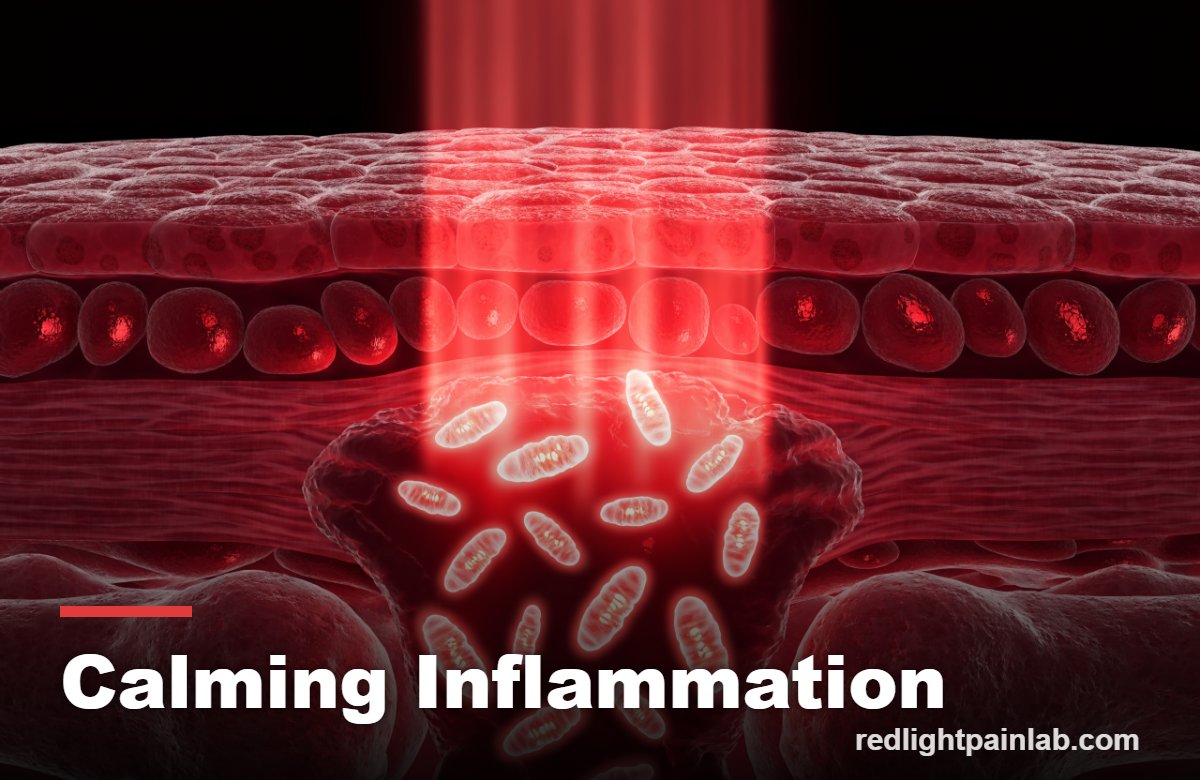
The light does its work at the level of your cells. Red (around 630 to 660 nm) and near-infrared (around 810 to 1064 nm) light is absorbed by an enzyme called cytochrome c oxidase inside your mitochondria, the part of the cell that makes energy. That absorption nudges the cell to produce more ATP (cellular energy) and changes its signaling, which is the foundation of every downstream effect (Hamblin, 2018).
On the inflammation side specifically, laboratory and animal studies show this cascade can shift the balance of cytokines, the chemical messengers that turn inflammation up or down. In a 2023 Stanford mouse study, near-infrared light reduced key pro-inflammatory cytokines (IL-1β and IL-18) and increased the anti-inflammatory cytokine IL-10 (Shamloo et al., 2023). Reviews of the mechanism describe a similar pattern, lower TNF-α, IL-6, and IL-1β, alongside better local circulation and reduced oxidative stress.
An honest caveat: a lot of that cytokine data comes from cells and animals. It explains why red light could ease inflammation, but it is not the same as proof that it lowers inflammation throughout the human body. For that, we look at what happened when real people used it for real inflammatory conditions.
What the human evidence actually shows
The strongest clinical evidence is for conditions where inflammation sits in a joint or tissue you can treat directly.
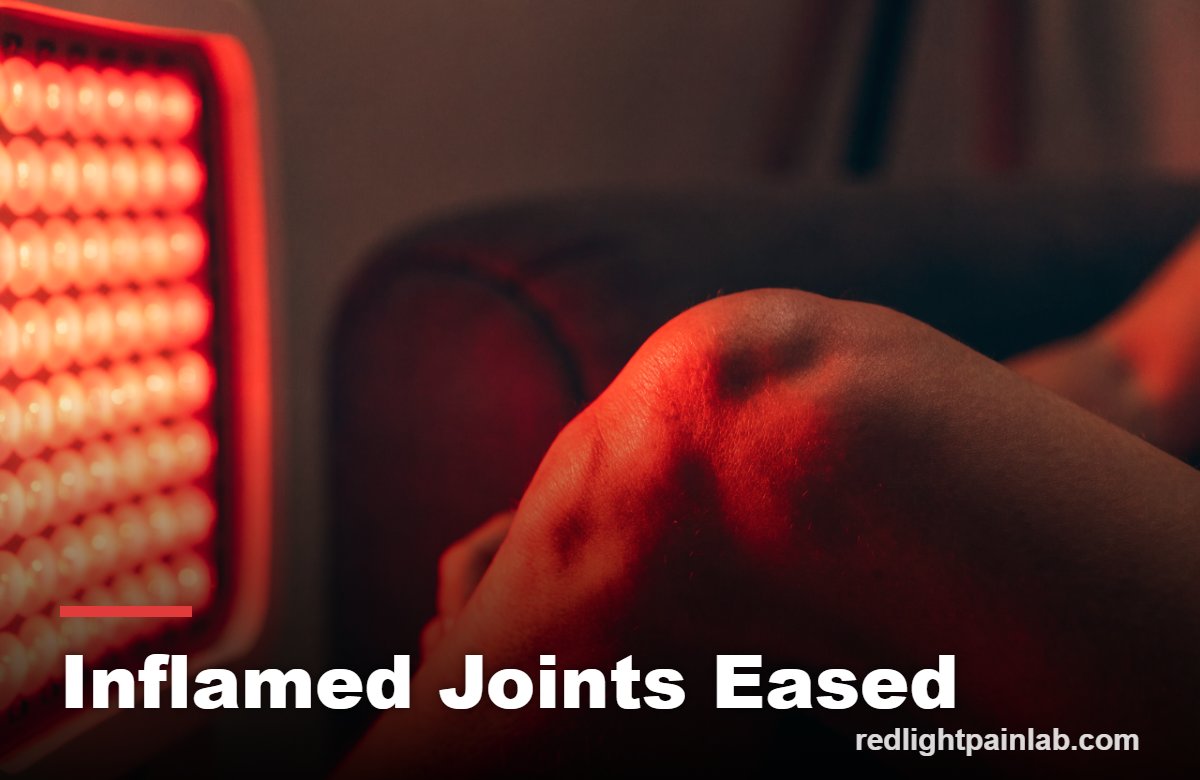
- Knee osteoarthritis. A 2019 meta-analysis of 22 randomized, placebo-controlled trials (1,063 people) found that low-level laser and light therapy reduced pain versus a sham device (Stausholm et al., BMJ Open 2019). Osteoarthritis is partly an inflammatory process, and this is the deepest evidence base in the field.
- Rheumatoid arthritis. A Cochrane review of 5 randomized placebo-controlled trials (222 people) found low-level laser therapy reduced pain by about 1.1 points on a 10-point scale and cut morning stiffness by roughly 27.5 minutes in the short term, with no reported side effects (Brosseau et al., Cochrane 2005). RA is a classic inflammatory disease, so this is a meaningful signal.
- Oral mucositis. This is worth knowing about even though it is not a pain-panel use, because it is the clearest guideline-level proof that light calms inflamed tissue. The MASCC/ISOO clinical practice guidelines recommend photobiomodulation to prevent oral mucositis, the painful mouth inflammation caused by chemotherapy and radiotherapy, in certain cancer patients (Elad et al., Cancer 2020). When a major oncology body recommends light therapy for an inflammatory injury, the anti-inflammatory effect is being taken seriously.
Put together: the case is good for treating a specific inflamed area, and it is consistent with the mechanism. The case is weak for using a panel as a general “anti-inflammatory” for your whole system.
What red light therapy will not do for inflammation
Keeping this honest is what makes the rest trustworthy.
- It will not reliably lower whole-body inflammation markers like CRP in an otherwise healthy person. You will see big percentage claims about this online; the solid human evidence is not there yet.
- It does not cure arthritis, autoimmune disease, or whatever is driving the inflammation. It manages symptoms.
- It is not a replacement for medication, physical therapy, or your doctor’s plan. Think of it as something you add, not something you swap in.
- Results build over weeks of consistent use, not overnight. If a device promises instant, dramatic results, be skeptical.
One regulatory note, because it gets misrepresented: home red light panels are FDA registered as general wellness devices. They are not FDA “cleared” or “approved” to treat inflammation as a disease.
Wavelength and depth: reaching the inflammation
For inflammation, the light has to actually reach the inflamed tissue, and depth depends on wavelength. Red light around 660 nm mostly treats the skin and surface. Near-infrared around 850 nm reaches into muscle. The deepest home wavelength, 1064 nm, penetrates toward joints and deeper structures. So inflamed finger joints (shallow) and an inflamed knee or lower back (deep) are not the same targeting problem. Our complete guide to the best red light therapy for pain breaks down the depth science and which devices actually deliver each wavelength.
How to use red light therapy for inflammation
A simple, evidence-aligned routine for a localized inflamed area:
- Bare the area. Light works best on clean skin; remove thick clothing or heavy creams over the spot.
- Set the distance. Most home panels are used around 6 to 12 inches (15 to 30 cm) from the skin, follow your device’s guidance.
- Treat 10 to 15 minutes per area, once or twice a day.
- Be consistent. Aim for 4 to 5 sessions a week for the first 4 to 6 weeks; inflammatory pain tends to ease gradually, not instantly.
- Pair it, don’t replace. Use it alongside movement, your prescribed treatment, and anything else your clinician recommends.

Inflammation by condition: go deeper
Inflammation shows up differently depending on where it is, and we have detailed, evidence-based guides for the most common areas:
- Red light therapy for arthritis pain, the inflammatory-joint hub, covering osteoarthritis and rheumatoid arthritis.
- Rheumatoid arthritis, the most clearly inflammatory, autoimmune case.
- Knee pain and hand arthritis.
- Muscle soreness, the short-term inflammation behind post-exercise aches.
- Elbow pain (tennis and golfer’s elbow), inflammatory tendon pain.
Devices we recommend
For inflammation, the device needs two things: enough near-infrared depth to reach the inflamed tissue, and enough treatment area to cover the joint or region comfortably. We rank devices on exactly those criteria, near-infrared output, irradiance, and independent testing, rather than on brand or commission. See our current picks in the top 5 red light therapy devices for pain, where three of the five include the deep-reaching 1064 nm wavelength that matters most for deeper inflamed joints.
Safety and who should check with a doctor first
Red light therapy is well tolerated, with side effects being uncommon and usually mild (temporary redness or warmth, or eye strain without proper eye protection). Still, talk to your doctor before starting if you are pregnant, take medication that increases light sensitivity (some antibiotics, retinoids, or photosensitizing drugs), have an active cancer in the area you want to treat, or have a thyroid condition and want to treat near the neck. Always protect your eyes from direct exposure, and treat new or worsening inflammation as a reason to get a medical opinion, not just a panel.
Frequently asked questions
Does red light therapy reduce inflammation?
It can reduce localized, tissue-level inflammation. Laboratory and animal studies show it shifts inflammatory cytokines in an anti-inflammatory direction, and human trials show pain benefit in inflammatory joint conditions like knee osteoarthritis and rheumatoid arthritis. It is not proven to lower whole-body inflammation in healthy people.
How long does it take to see anti-inflammatory results?
Most people use it for 4 to 6 weeks before judging it. Inflammatory pain usually eases gradually with consistent sessions (4 to 5 times a week), not after a single use.
Which wavelength is best for inflammation?
It depends on depth. Around 660 nm suits surface and shallow tissue; 850 nm reaches muscle; 1064 nm penetrates toward deeper joints. Deeper inflamed areas like the knee or lower back benefit from near-infrared and 1064 nm.
Can I use red light therapy with anti-inflammatory medication?
Yes. Photobiomodulation has no known negative interaction with NSAIDs or other anti-inflammatory drugs, and clinical trials have used it alongside standard care. Use it as an add-on, and keep your doctor in the loop.
Is red light therapy FDA approved for inflammation?
No. Home red light panels are FDA registered as general wellness devices, not cleared or approved to treat inflammation as a medical condition.
The bottom line
Red light therapy is a reasonable, low-risk tool for calming localized inflammation, especially in inflamed joints, where the human evidence is strongest. It works by changing how your cells handle energy and inflammatory signaling, it pairs safely with standard treatment, and it asks only for consistency. Just keep the expectation honest: it eases inflamed tissue you treat directly; it is not a whole-body anti-inflammatory or a cure.
References
- Shamloo S, Defensor E, Ciari P, et al. The anti-inflammatory effects of photobiomodulation are mediated by cytokines: Evidence from a mouse model of inflammation. Frontiers in Neuroscience. 2023;17:1150156. Link
- Hamblin MR. Mechanisms of photobiomodulation (cytochrome c oxidase, ATP). Photochemistry and Photobiology. 2018. Link
- Stausholm MB, Naterstad IF, Joensen J, et al. Efficacy of low-level laser therapy on pain and disability in knee osteoarthritis: systematic review and meta-analysis of 22 randomised trials. BMJ Open. 2019;9:e031142. Link
- Brosseau L, Robinson V, Wells G, et al. Low level laser therapy for rheumatoid arthritis. Cochrane Database of Systematic Reviews. 2005. Link
- Elad S, Cheng KKF, Lalla RV, et al. MASCC/ISOO clinical practice guidelines for the management of mucositis secondary to cancer therapy. Cancer. 2020;126(19):4423-4431. Link
Medical disclaimer: This article is for information only and is not medical advice. Red light therapy panels are FDA registered as general wellness devices, not cleared or approved to treat inflammation. Consult a qualified healthcare professional before starting any new treatment.