
Short answer: yes, it can help, but not in the way most people expect. It is not a magic button that erases soreness the moment you stand in front of a panel. What it does, when used correctly and consistently, is take the edge off the deep, achy soreness that shows up a day or two after you push your body, and help you bounce back faster. I am going to walk you through both sides of this honestly: what the science actually shows, where it falls short, and what I learned from leaning on red light therapy through one of the hardest physical stretches of my life.
I will be upfront about my bias. I believe in this technology. But I am not going to oversell it to you, because the people who oversell red light therapy are the reason a lot of skeptics roll their eyes at it. Let me give you the full picture instead.
Table of Contents
- My Own Story
- What Actually Causes Muscle Soreness
- How Red Light Therapy Works on Sore Muscles
- What the Science Actually Shows
- What Real People Say About It
- The Protocol I Actually Used
- Red Light Therapy Is Not a Substitute for Movement
- So, Should You Try It
- The Thing Nobody Warns You About
- Real Reddit Experiences
My Own Story: Two Major Surgeries in Ten Months
This is not theory for me. In the span of ten months, I went through two serious operations: an S1 to L2 spinal fusion in my lower back, and a total right hip replacement. Anyone who has been through one of those, let alone both back to back, knows the recovery is supposed to be brutal. Weeks of pain medication. Disrupted sleep. Slow, painful first steps. A life basically on hold.
That is not how it went for me.
I used no painkillers. I was walking by day two after both surgeries. I did not lose sleep to pain. I did not lose my life to the recovery. My doctors and the physical therapy team told me my recovery was remarkable, and they do not throw that word around lightly.
Was red light therapy the only reason? No, and I want to be honest about that. My recovery was a combination of things: the surgeons did excellent work, I stayed mentally committed, and I made deliberate lifestyle choices, which I will get into below. But red light therapy was a daily, non-negotiable part of that protocol, and I am convinced it played a real role in how fast and how comfortably I healed. My mitochondria were happy, and so was I.
I want to be clear about what this story is: it is one person’s experience, not a controlled clinical trial. My result does not prove anything on its own. But it is real, it is mine, and it is the reason I take this topic seriously instead of treating it as a wellness fad.
What Actually Causes Muscle Soreness

Before we talk about whether light can fix soreness, it helps to understand what soreness even is.
The deep, achy stiffness you feel a day or two after hard or unfamiliar exercise has a name: delayed onset muscle soreness, or DOMS. It usually shows up 24 to 72 hours after you train, and it tends to come from eccentric or unaccustomed effort, the kind of movement your body is not used to yet.
The leading explanation is that intense effort causes microscopic damage to your muscle fibers and the connective tissue around them. That microtrauma triggers a local inflammatory response, and that inflammation is a big part of what you actually feel as soreness, stiffness, tenderness, and a temporary drop in strength and range of motion.
That detail matters, because it tells you where red light therapy might fit in. If soreness is driven heavily by inflammation and a slow cellular repair process, then a tool that influences inflammation and cellular energy has a logical place in the conversation.
How Red Light Therapy Works on Sore Muscles
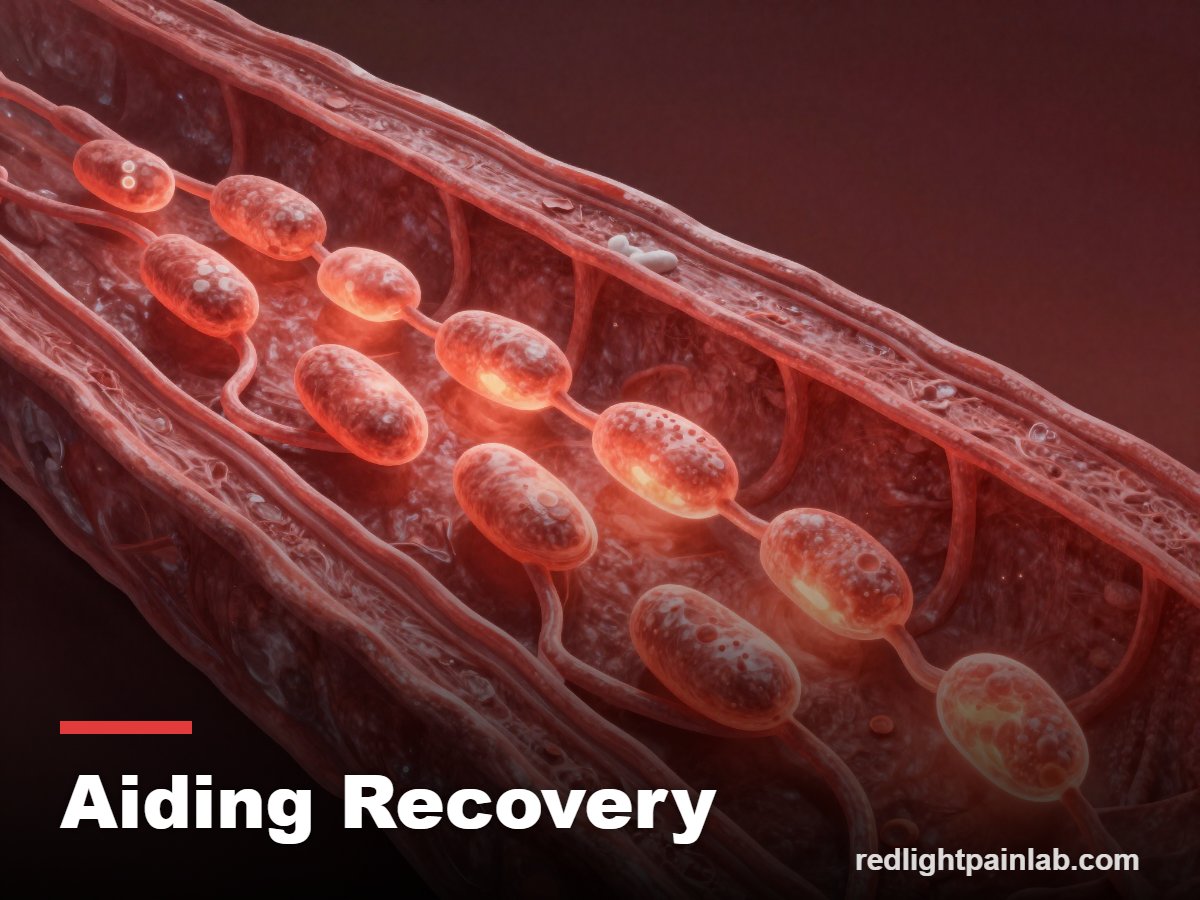
Red light therapy, also called photobiomodulation, uses specific wavelengths of red and near-infrared light that penetrate the skin and reach the tissue underneath. Red light in roughly the 630 to 660 nanometer range works on the skin and shallower tissue. Near-infrared light, in the 800 nanometer-plus range, penetrates deeper to reach muscle and connective tissue. That depth is exactly why near-infrared matters so much for soreness and recovery.
Here is what the research suggests is happening at the cellular level when that light hits sore muscle:
- It stimulates an enzyme in your mitochondria called cytochrome c oxidase, which increases the production of ATP, the energy your cells use to repair themselves.
- It appears to reduce oxidative stress and tamp down pro-inflammatory signaling, which lowers the sensitization of the nerve endings that report pain.
- It boosts local circulation through increased nitric oxide, which improves blood flow and helps clear inflammatory byproducts out of the area.
In plain language: it helps your cells make more energy to repair, calms the inflammation that drives the ache, and improves the local “plumbing” so your body can flush out the junk and bring in what it needs to heal. That is the mechanism, and it is grounded in real biology, not marketing.
What the Science Actually Shows
This is where I want to be careful and honest with you, because the evidence is genuinely promising but it is not unanimous.
A 2025 systematic review and meta-analysis published in the Journal of Functional Morphology and Kinesiology looked specifically at photobiomodulation for DOMS. The researchers pulled together 14 controlled studies. When they ran the numbers on the studies with enough data to combine, here is what they found:
- A statistically significant reduction in perceived muscle soreness (measured on a visual analog pain scale) at 72 hours and 96 hours after soreness was induced, described as a moderate effect.
- A statistically significant improvement in muscle strength recovery at 24 hours and 48 hours, described as a large effect.
- Reductions in biochemical markers of muscle damage, including creatine kinase, in several of the studies.
That last point is important. It suggests red light therapy is not just masking how sore you feel. In several trials it actually lowered the blood markers of muscle damage, which hints that it may support the underlying repair, not only the perception of pain.
One older randomized trial worth highlighting: after a damaging biceps exercise, a single LED light treatment applied right after the workout led to significantly less soreness, less loss of strength, and better range of motion over the following days compared to a placebo group. That fits the pattern of using light right around the time of effort.
Now the honest caveat. In that same 2025 review, of the 14 studies, 10 reported positive effects and 4 reported no significant benefit. The studies also varied a lot in wavelength, dose, and how the light was applied, and the researchers were candid that this variability makes it hard to draw one clean conclusion. Their own bottom line was that photobiomodulation “may be” an effective intervention for DOMS, and that more high-quality studies are still needed.
So if someone tells you red light therapy is scientifically “proven” to eliminate soreness every time, they are overstating it. And if someone tells you it is pure placebo with good marketing, they are ignoring a real and growing body of evidence. The truth sits in the middle: the science says it works under the right conditions, with the right wavelengths, dose, and consistency. The protocol is doing a lot of the work.
What Real People Say About It
Beyond the studies, it is worth listening to what regular athletes and gym-goers report, because their experience tends to echo the research, including the inconsistency.
Across running, lifting, and biohacking communities, the common themes are remarkably consistent. Many people describe their legs feeling noticeably less “cooked” the day after a long run or a heavy session. A frequent way people put it is that red light therapy is not magic, but it shortens their recovery window enough to keep their training quality high during hard blocks. Others are blunt that for them it did little beyond being a warm, relaxing ritual.
Practitioners who work with athletes tend to land in a sensible place too. Sports medicine voices generally frame red light therapy as a low-risk, non-invasive add-on that layers nicely on top of the real fundamentals of recovery, sleep, nutrition, hydration, and active movement, rather than a shortcut that replaces them. That matches my view exactly.
The honest takeaway from the community is the same as the honest takeaway from the labs: it helps a lot of people meaningfully, it does little for some, and how you use it matters enormously.
The Protocol I Actually Used

People always want the specifics, so here is exactly what I did rather than a vague “I used red light.” I used a full-body panel, the RLT Home Total Spectrum Elite, and ran the same recovery-focused settings before and after both surgeries:
- Mode: the Total Spectrum Elite’s built-in Pain and Inflammation mode, a recovery setting that emphasizes strong near-infrared, including deeper 1064 nanometer output for deeper tissue support. This is the setting geared toward muscle recovery, joint stress, sprains, strains, and inflammation.
- Distance: about one to two feet from the panel.
- Duration: 15 minutes per session.
- Position: I would stand, sit, or lie down depending on the area I was targeting. For full lower-body recovery, lying face down so the back, glutes, hamstrings, calves, and feet all caught the light at once.
- Consistency: this was the part I never skipped. Daily, not occasionally.
The only thing I added was a relaxing cream a couple of hours after my session, well separated from the light itself. That was it. Simple, repeatable, and done every single day.
If you take one practical thing from this section, let it be the consistency. The research and the community both point to the same lesson: red light therapy rewards regular use across a stretch of time, not a one-off session when you happen to feel sore.
Red Light Therapy Is Not a Substitute for Movement
This is the part I refuse to skip, because it is the part that actually made the difference for me.
Red light therapy is not a replacement for rest, movement, and sensible living. It is a multiplier on top of them. During my recovery, there was a stretch where I was avoiding long walks for weeks because I was being cautious. As I kept up my daily light sessions and started feeling stronger, I deliberately added walking back into my routine, then gentle stretching. That balance, light therapy plus a gradual return to real movement, is what made the whole thing work.
If you are sore from training, the same principle applies. Use red light therapy as part of a complete approach: sleep, hydration, protein, gentle active recovery, and patience. The light supports your body’s repair process. It does not do the repairing for you, and it does not give you permission to skip the fundamentals.
So, Should You Try It?
Here is my honest opinion, and you can take it as one person’s strong view rather than a guarantee.
If you are dealing with stubborn muscle soreness, slow recovery, or lingering inflammation and the usual approaches are not getting you where you want to be, red light therapy is worth a real try. It is science-backed, it is non-invasive, it carries minimal reported downside, and at worst you have added a relaxing 15-minute habit to your day. At best, as it did for me, it becomes a genuine pillar of how your body recovers.
Just go in with the right expectations. Use proper wavelengths, especially deep near-infrared for muscle. Be consistent. Pair it with movement and good habits. And do not expect it to erase soreness instantly the first time you stand in front of a panel.
The Thing Nobody Warns You About: Using the Panel Right
I want to close on the single biggest reason people buy a red light panel and end up disappointed, because almost no one talks about it.
It is not that the technology fails them. It is that the panel arrives, they unbox this powerful device, and then they have no idea how to actually use it. Which mode? How long? How far away? Which area, in what position, how often? It is genuinely confusing, and confusion leads to inconsistent, half-hearted use, which leads to weak results, which leads people to conclude red light therapy “doesn’t work.” In reality, the protocol was the problem the whole time.
This is exactly why I personally recommend going with a setup that gives you a personalized plan after you buy. The panel I used, the RLT Home Total Spectrum Elite, did exactly that, it paired the device with a clear, tailored protocol telling me which mode to use, how long, how far, and for which goal. When the device shows up that way, you skip the confusion entirely and you actually use the thing correctly from day one. In my opinion, that guidance is not a nice-to-have. It is the difference between a panel that gathers dust and a panel that genuinely changes how you recover.
If you want to compare your options before you commit, I put together a breakdown of my top 5 red light therapy panels for pain, including the one I used through my own recovery. It is a good place to start if you are trying to figure out which device actually fits your needs.
The science is real. The mechanism is sound. The results, for a lot of people including me, are remarkable. But none of that matters if the device sits in a corner because you were not sure how to use it. Get the protocol right, stay consistent, pair it with movement, and give red light therapy a fair shot. It earned my belief the hard way.
Real Red Light Therapy Experiences on Reddit
These are real, unpaid posts from public red light therapy and pain communities on Reddit. They are personal anecdotes about recovery, not clinical proof, but they show how everyday users describe their results. Each links to the original thread so you can read the full discussion.
r/redlighttherapy
Healed my foot injury within 2 days with RED/NIR in 2 sessions
A user treated a hard foot impact with 25-minute red and near-infrared sessions and said the bruise was almost gone within a few days. In their words: “By day 3 the bruise was almost gone.”
r/redlighttherapy
Been using a red light panel for two months. My experience so far
After two months of daily panel use, this user reported better sleep and clearer skin, and that the light helped with pain and faster bruise healing. In their words: “As for pain, the red light helps.”
r/backpain
Chronic lower back stiffness for 7 years, is red light actually legit?
A skeptic asked whether red light is legit for years of stiffness; a long-time sufferer replied it cut their throbbing, muscle spasms, stiffness and swelling after trying everything else. In their words: “It has toned down 80% of the throbbing and muscle spasms.”
Disclaimer: The Reddit posts above are third-party personal experiences shared by individual users. They are anecdotal, not medical evidence. Results vary and are not verified or endorsed by RedLightPainLab. Always consult a qualified professional before starting red light therapy.
This article reflects personal experience and a review of published research. It is not medical advice. If you are recovering from surgery, an injury, or a medical condition, talk to your doctor or physical therapist before adding red light therapy to your routine.