
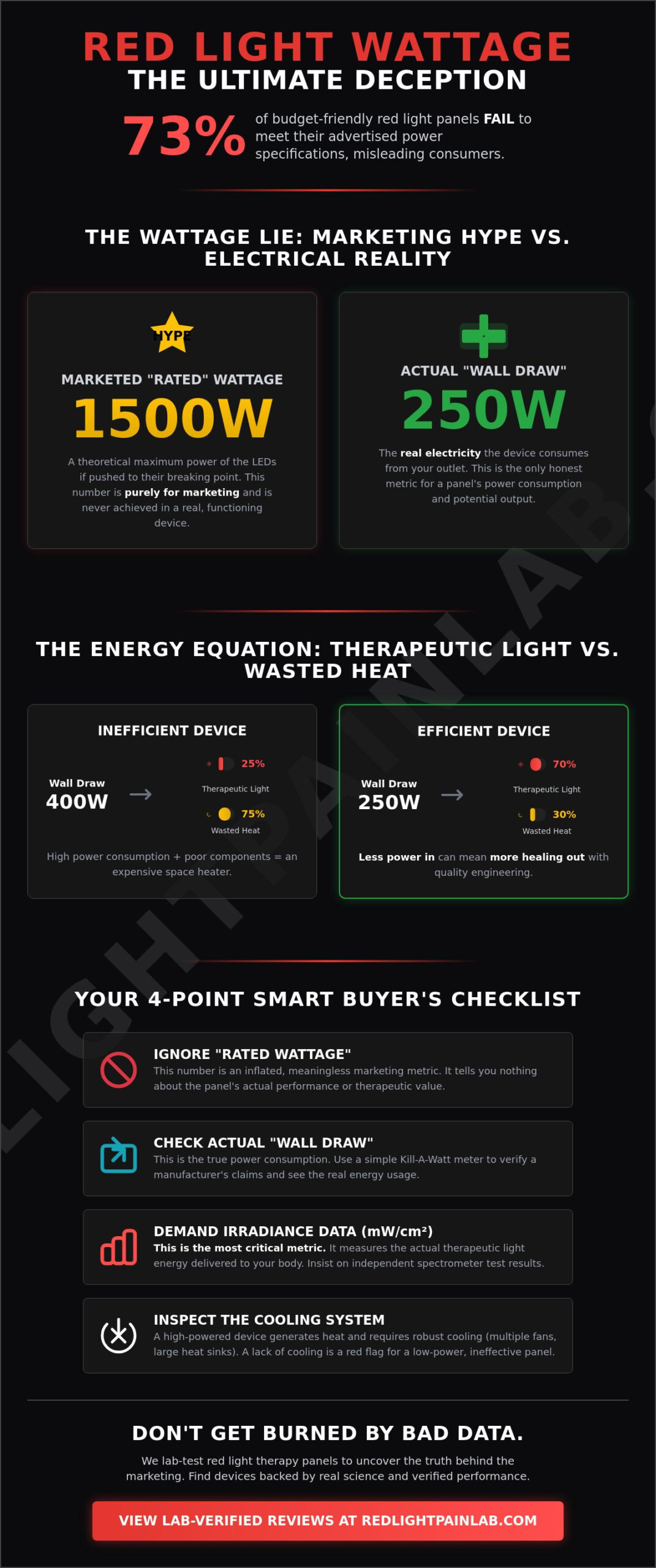
Did you know that 73% of budget-friendly red light therapy panels fail to meet their advertised irradiance specifications? This staggering discrepancy exists because many manufacturers prioritize marketing metrics over biological efficacy. You might feel overwhelmed by contradictory claims of “rated wattage” versus “actual power consumption,” fearing that a cheaper device won’t penetrate deep enough to provide the relief you need. It is a valid concern in a marketplace often characterized by technical obfuscation rather than clinical transparency.
In this guide, we provide red light therapy panel wattage explained with the precision of a laboratory report. You will learn the critical difference between the electricity a device pulls from your wall and the actual therapeutic energy delivered to your cells. We’ll strip away the hype to reveal a clear framework for evaluating panel power, allowing you to calculate a precise dose with confidence. By the end of this investigation, you will understand how to identify clinical-grade equipment that adheres to modern safety standards like IEC 62471 without falling for inflated power claims.
- Understand the critical distinction between electrical wall draw and therapeutic light output to avoid paying for inefficient heat energy.
- See the red light therapy panel wattage explained through the lens of LED efficiency and the biphasic dose response of the Arndt-Schulz Curve.
- Learn to calculate your actual dosage using irradiance measurements and the Inverse Square Law rather than relying on misleading “rated” power.
- Equip yourself to spot marketing manipulation, including the use of inaccurate solar power meters and “peak wattage” claims.
- Gain a methodical framework for selecting devices backed by independent spectrometer testing and recognized safety certifications.
Table of Contents
- The Wattage Myth: Distinguishing Wall Draw from LED Rated Power
- LED Efficiency: Why Higher Power Consumption Doesn’t Equal Better Results
- Irradiance vs. Wattage: Calculating the True Therapeutic Dose
- Critical Spec Analysis: How to Spot Marketing Manipulation
- Navigating the Market: Selecting Lab-Verified Panels for Clinical Efficacy
The Wattage Myth: Distinguishing Wall Draw from LED Rated Power
Have you ever wondered why two panels with the same “1000W” label have vastly different price points and physical weights? The answer lies in a fundamental misunderstanding of electrical terminology. In this context, wattage represents electrical consumption. It is a measurement of how much power the device draws from your home’s electrical grid, not a measurement of the therapeutic light emitted toward your body. This distinction is the cornerstone of having red light therapy panel wattage explained correctly.
Most consumer-grade panels use “Rated Wattage” as a marketing headline. This number represents the theoretical maximum capacity of the LED chips if they were pushed to their absolute breaking point. However, in practice, reputable manufacturers “under-drive” these LEDs. A chip rated for 5 watts might only be supplied with 1.8 watts of actual power. Why do they do this? It’s a calculated engineering choice to prevent overheating and ensure the device lasts for years rather than hours. This practice is standard in the development of Low-level laser therapy (LLLT) devices, where thermal management is as critical as light frequency. If a manufacturer actually ran a 1000W-rated panel at its full capacity, the internal components would likely melt within minutes.
The 3-Watt vs. 5-Watt LED Marketing Trap
Many shoppers assume a 5W LED is inherently superior to a 3W LED. This is a common misconception. High-quality 3W chips are often more efficient at converting electricity into light, whereas 5W chips frequently generate a disproportionate amount of wasted heat. Dual-chip designs, which house two diodes in a single lens, further complicate these spec sheets by doubling the “rated” numbers without necessarily doubling the irradiance. Higher LED ratings often lead to excessive heat, not more light. When an LED gets too hot, its light output actually drops, meaning a “more powerful” chip could provide less therapy.
Why Actual Power Consumption (Wall Draw) is the Only Number That Matters
If you want the truth, ignore the box and look at the “wall draw.” This is the actual power consumption of the entire unit, including the LEDs, internal drivers, and cooling fans. You can easily verify this yourself using a simple Kill-A-Watt meter. If a panel claims to be a 1500W powerhouse but only pulls 250W from the wall, you’re looking at a massive gap between marketing and reality. At RedLightPainLab, we prioritize wall draw in all lab-tested reviews because it provides a grounded starting point for calculating energy density. A higher wall draw typically necessitates more robust cooling fans, which is a physical indicator of a device’s true power capacity. Without sufficient fans, a high-wattage device is simply a fire hazard.
LED Efficiency: Why Higher Power Consumption Doesn’t Equal Better Results
Why do we instinctively assume that higher wattage equals faster healing? In the physics of photobiomodulation, higher power consumption often signals poor engineering rather than superior biological output. When evaluating red light therapy panel wattage explained in technical terms, we must look at the efficiency of energy conversion. LEDs are semi-conductors that convert electrons into photons, but this process is never 100% efficient. Any energy not converted into light is released as thermal energy. If a panel pulls massive amounts of electricity but lacks high-quality optical lenses, you aren’t achieving deeper tissue penetration. You’re simply operating an expensive space heater.
The role of the internal driver is paramount here. High-quality drivers maintain a stable power output, ensuring that the LEDs receive a consistent current without fluctuations. In contrast, cheap drivers often result in “flicker,” a rapid pulsing of light that can cause headaches or eye strain. A panel with lower wall draw but superior drivers and efficient chips will often outperform a high-wattage competitor by delivering a cleaner, more stable stream of photons to your mitochondria. To see how these technical specs translate to real-world performance, you can explore our lab-tested reviews where we measure actual output efficiency.
Heat: The Silent Killer of Red Light Efficacy
Heat is the primary antagonist of LED longevity and performance. As a panel runs during a 10-minute session, the internal temperature rises. If the device lacks sufficient heat sinks or active cooling fans, the “forward voltage” of the LEDs shifts, causing the light output to degrade mid-session. You might start with a high intensity, but by minute eight, the actual light reaching your skin has diminished significantly. A hot panel is a clear indicator of poor electrical efficiency. This is particularly relevant for dermatological applications, as Harvard Health Publishing notes that controlled, consistent light is necessary for skin-related benefits without the risk of thermal damage.
The Arndt-Schulz Curve and the Therapeutic “Sweet Spot”
In the scientific community, we refer to the biphasic dose response, or the Arndt-Schulz Curve. This principle dictates that there is a specific “sweet spot” for light therapy: low doses stimulate cellular activity, while excessively high doses actually inhibit repair. If a panel is over-powered, you run the risk of accidental over-dosing. Instead of activating cytochrome c oxidase in your mitochondria, a massive surge of energy can induce oxidative stress, rendering the session useless or even counterproductive. In 2026, the therapeutic window for red light therapy is defined as the precise range of energy density that triggers mitochondrial activity without crossing the threshold into cellular inhibition. Raw power is a blunt instrument; precision is the surgical tool required for clinical results.
Irradiance vs. Wattage: Calculating the True Therapeutic Dose
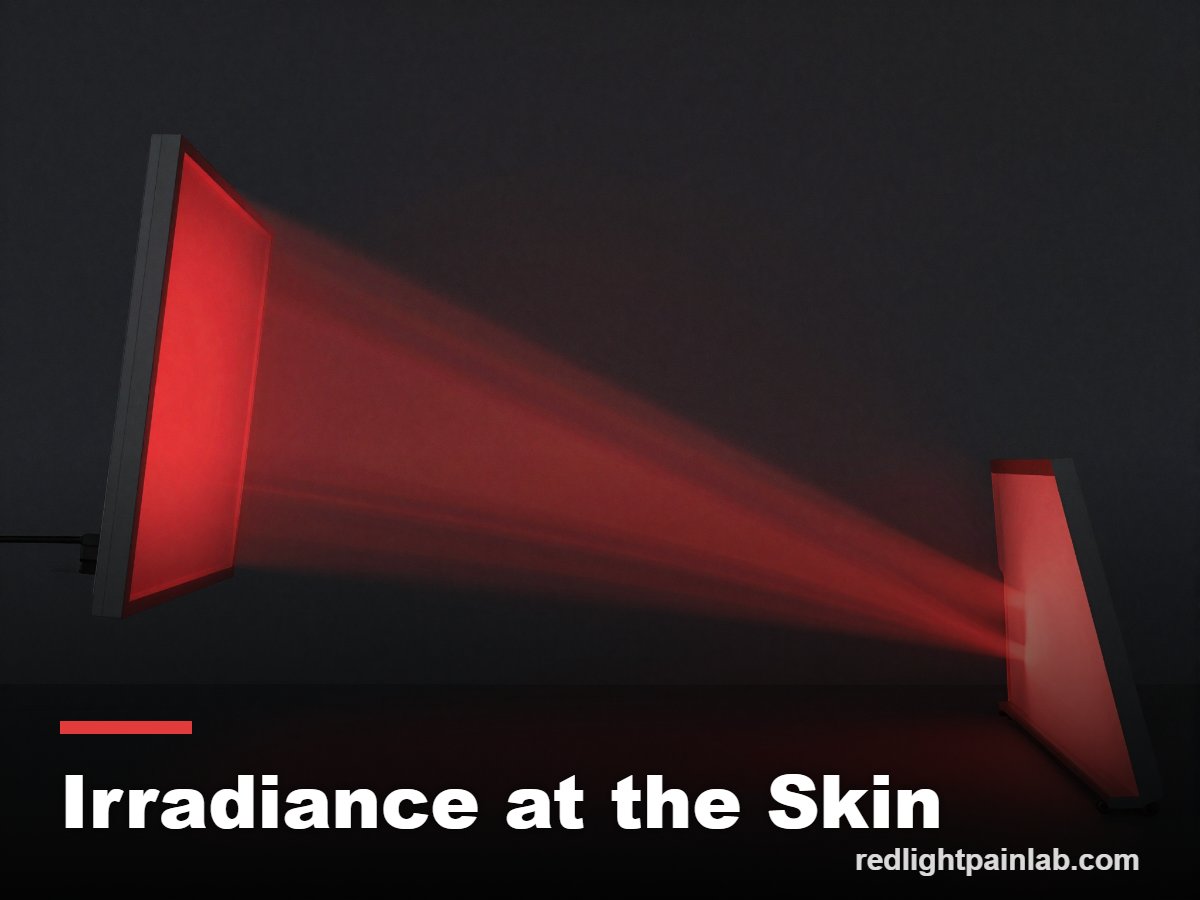
Why does a panel with lower electrical consumption often yield superior biological results? The answer is found in irradiance, the measurement of light intensity reaching a specific surface area, typically expressed in milliwatts per square centimeter (mW/cm²). While we have already had red light therapy panel wattage explained as an electrical input, irradiance is the actual clinical output. A panel might pull 500 watts from the wall, but if that energy is scattered across a wide area without focused lenses, the therapeutic density remains insufficient for deep tissue penetration. A low-wattage panel equipped with secondary optical lenses can outperform a high-wattage floodlight by ensuring photons are directed into the dermis rather than lost to the surrounding room.
Precision in dosing is not merely a preference; it is a clinical necessity. According to an American Dental Association technical report, distinguishing between total power and power density is vital for ensuring efficacy in photobiomodulation. Without this distinction, you are likely to miscalculate the energy delivered to your target cells. To achieve results, you must look past the electrical “bulk” and focus on the concentration of light reaching your skin.
The Inverse Square Law in At-Home Setups
The Inverse Square Law states that the intensity of light is inversely proportional to the square of the distance from the source. In practical terms, standing 12 inches away from your panel instead of 6 inches doesn’t just halve the power; it reduces the effective irradiance to one-quarter of the original intensity. Your choice of beam angle further complicates this. Lenses with a 30-degree beam angle concentrate electrical power into a tight, high-intensity column, making them ideal for targeted deep-tissue pain. Conversely, 90-degree angles spread the same wattage over a larger area, which is suitable for general skin health but requires much longer sessions to reach the same therapeutic threshold.
Joules vs. Watts: Understanding Your Daily Dose
In the lab, we don’t measure success in watts; we measure it in Joules. A Joule is the unit of total energy actually absorbed by the mitochondria over time. To calculate your dose, you must multiply the panel’s verified irradiance by the duration of your session. Consider a scenario where you are treating chronic back pain with a high-quality 300W wall-draw panel. If the device delivers a verified 100 mW/cm² at a distance of 6 inches, a 10-minute session (600 seconds) provides a total dose of 60 Joules per square centimeter. This is a robust, clinical-grade dose for spinal tissue. If you move back to 12 inches, you might need to double or triple your session time to achieve that same 60-Joule target.
Critical Spec Analysis: How to Spot Marketing Manipulation
How do you know if a brand is being honest about their technical specifications? Having red light therapy panel wattage explained is only half the battle; you must also understand how those numbers are measured and presented. Many manufacturers exploit the lack of consumer technical knowledge by using “Peak Wattage” in their marketing headlines. This value represents a momentary burst of energy that the internal components cannot sustain without failing. For clinical efficacy, you need the “Continuous Wattage” or actual wall draw. This determines the steady, reliable stream of energy your mitochondria receive during a full session. If a spec sheet doesn’t specify “continuous” draw, you’re likely looking at an inflated, theoretical number.
The gap between advertised power and reality is wider than most realize. Independent testing has revealed that 73% of budget-friendly red light therapy panels do not meet their advertised irradiance specifications. This is not just a minor rounding error; it is a fundamental failure to deliver the promised therapeutic dose. When a device is underpowered, it fails to reach the depth required for joint or muscle recovery, leaving you with a surface-level treatment that doesn’t justify the cost. To avoid these pitfalls, you can browse our verified panel reviews where we perform the data analysis for you.
The Solar Power Meter Scam Explained
Why do so many budget panels claim irradiance levels of 150 mW/cm² or higher? They are likely using a $20 solar power meter to generate their data. These devices are calibrated for broad-spectrum sunlight, not the narrow-band light emitted by 660nm and 850nm LEDs. Because of this calibration error, solar meters often inflate irradiance readings by 200% to 300%. A professional spectrometer is the only instrument capable of providing an accurate measurement of narrow-band light. Before finalizing a purchase, ask the manufacturer for a third-party lab report conducted with a spectrometer. If they refuse or provide a screenshot of a hand-held solar meter, the data is scientifically invalid.
Balancing Power with Safety: EMF and Flicker
Is a high-wattage panel always safe for close-range use? Not necessarily. The large transformers required for high-wattage output can emit significant Electromagnetic Fields (EMF) if they are poorly shielded. High EMF exposure at a close therapeutic distance can potentially counteract the anti-inflammatory benefits of the light. According to ICNIRP Guidelines, EMF readings at a distance of 6 inches should be significantly under 3µT. Additionally, high-wattage panels often struggle with stable DC power conversion, leading to light flicker. This rapid pulsing can trigger neurological fatigue or eye strain. You should prioritize devices that guarantee “Zero-EMF” at 6 inches and maintain a flicker rate below 8%, ensuring your treatment is both safe and restorative.
Navigating the Market: Selecting Lab-Verified Panels for Clinical Efficacy
How do you synthesize these technical specifications into a confident purchasing decision? We have already had red light therapy panel wattage explained as a metric of consumption rather than clinical output. Now, you must apply this investigative lens to the current market. Selecting a device requires moving beyond the “rated power” listed on a sales page and demanding proof of biological efficacy. A reputable manufacturer will treat their technical specifications with the same rigor as a medical device company, providing transparency that protects the consumer from underperforming hardware.
RedLightPainLab vets panels based on independent spectrometer testing to bridge the gap between marketing claims and reality. We look for third-party certifications that validate both safety and performance. In 2026, clinical safety for these devices is governed by the IEC 60601-2-57:2026 standard. Additionally, you should verify if a panel is FDA 510(k) cleared. This clearance indicates that the device is substantially equivalent to a legally marketed medical device, a process that can cost manufacturers between $20,000 and $100,000 to obtain. If a brand lacks these credentials, they are likely cutting corners in their engineering or quality control.
The Importance of Independent Lab Verification
What should you look for in a third-party lab report? A legitimate report must include Spectral Irradiance graphs. These charts show the exact intensity of light at specific wavelengths, proving that the panel actually emits the 660nm or 850nm light it claims. Transparency in power specs is a hallmark of a reputable brand. When a company provides verified wall draw data alongside spectrometer results, they are demonstrating a commitment to scientific validation. You can use our comparison tools to filter devices by these verified metrics, ensuring your investment goes toward photons, not just electricity.
Finding Your Specific Power-to-Pain Ratio
Does everyone need a high-wattage panel? Not necessarily. Your health goals dictate your power requirements. If you are focused on surface-level skin rejuvenation, a medium-power panel with a wider beam angle is often the best “all-rounder” for home use. However, if you are targeting deep-tissue injuries or chronic joint pain, you require the concentrated irradiance that only a high-efficiency device can provide. Many advanced users now favor modularity. Buying two medium-sized panels and linking them together is often better than buying one massive high-wattage unit. This setup allows for better heat dissipation and the flexibility to target different anatomical areas simultaneously.
Before you click “buy,” run through this final checklist:
- Is the “actual power consumption” or “wall draw” clearly stated?
- Does the brand provide spectrometer data from a third-party lab?
- Is the device FDA 510(k) cleared and compliant with IEC 60601 standards?
- Does the cooling system appear robust enough to handle the continuous wattage?
Ready to make a decision? Explore our 2026 rankings of the most efficient red light therapy panels to find a device that meets our rigorous lab standards.
Mastering Your Therapeutic Energy
Understanding the technical nuances of light physics is the only way to ensure your investment translates into biological recovery. We have provided red light therapy panel wattage explained through a lens of clinical precision, moving beyond the inflated “rated” numbers found on most sales pages. You now possess the framework to distinguish between simple electrical consumption and the actual irradiance required for deep tissue penetration. By focusing on wall draw, spectrometer-verified data, and the Inverse Square Law, you can avoid the common pitfalls of marketing manipulation and accidental under-dosing.
The path to effective photobiomodulation shouldn’t be obscured by technical deception. You deserve a device that adheres to modern safety standards while delivering a stable, flicker-free stream of photons. To simplify your search, we have performed the heavy lifting of data analysis so you don’t have to. View our lab-tested reviews of the best red light therapy panels for 2026 to access our spectrometer-verified irradiance data, independent EMF and flicker testing, and research-backed dosing protocols. Take control of your healing journey with the confidence that comes from lab-tested objectivity. Your cells will thank you for the precision.
Frequently Asked Questions
Is a higher wattage red light therapy panel always better?
No. Higher wattage often indicates poor electrical efficiency or excessive heat generation rather than superior therapeutic output. True efficacy is determined by irradiance and the quality of the optical lenses. A lower-wattage panel with focused 30-degree lenses can deliver more photons to deep tissue than a high-wattage device that scatters energy across a wide, shallow area.
What is the difference between rated wattage and actual power consumption?
Rated wattage represents the theoretical maximum capacity of the LED chips, while actual power consumption, or wall draw, is the real electricity the device utilizes. Manufacturers under-drive LEDs to prevent hardware failure. When having red light therapy panel wattage explained, it’s vital to prioritize wall draw, as this metric reflects the actual energy available to power the light diodes and cooling systems.
How many watts do I need for deep tissue pain relief?
You should focus on irradiance rather than raw watts, seeking a minimum of 100 mW/cm² at your treatment distance. For deep tissue penetration, panels with a wall draw of 200W to 300W typically possess the thermal management necessary to drive photons into joints and muscles. Units with lower consumption levels are often restricted to superficial skin treatments due to limited power density.
Can a high-wattage panel cause skin damage or burns?
Yes, if the device lacks sufficient active cooling or is used improperly. While the light itself is non-thermal, the heat byproduct from inefficient high-wattage electronics can cause thermal stress or surface burns. Reputable panels incorporate robust heat sinks and fans to maintain a safe operating temperature, ensuring you receive mitochondrial stimulation without the risk of accidental heat damage from the hardware.
Does wattage affect the treatment time required?
Indirectly, yes, because higher wattage units often provide higher irradiance, allowing you to reach a therapeutic Joule target faster. A high-efficiency device might achieve a clinical dose in 10 minutes, whereas an underpowered unit could require 30 minutes for the same result. You must verify these claims with spectrometer data, as high power consumption doesn’t always translate to shorter session times if the lenses are inefficient.
Why do some brands claim 1500W but only pull 300W from the wall?
This is a common marketing tactic that highlights “LED Rated Power” instead of actual consumption. They calculate the theoretical maximum of every chip, such as 300 chips at 5W each, even though the internal drivers only supply a fraction of that power. This discrepancy is why red light therapy panel wattage explained accurately must always distinguish between theoretical peak ratings and continuous wall draw.
What is the ideal irradiance for a home red light therapy device?
The ideal clinical range is between 100 mW/cm² and 150 mW/cm² at a distance of 6 inches. This intensity provides enough photon density to trigger cellular repair without inducing oxidative stress. According to independent testing, devices providing less than 60 mW/cm² are generally underpowered for systemic recovery, though they may suffice for basic dermatological applications where deep penetration isn’t required.
Do high-wattage panels have higher EMF levels?
They can, as larger transformers and higher electrical currents naturally generate more significant electromagnetic fields. However, superior engineering includes internal shielding to mitigate this risk. You should seek panels that maintain EMF readings significantly under 3µT at a 6-inch distance. Poorly shielded high-wattage units can emit levels that exceed ICNIRP guidelines, potentially counteracting the biological benefits of your treatment.