
By the RedLightPainLab Research Team · Published June 9, 2026 · Last updated June 9, 2026
Affiliate disclosure: Some links below are affiliate links. We may earn a commission at no extra cost to you. We are independent; rankings are based on our methodology and are never paid for.
Red light therapy, also called photobiomodulation or low-level laser therapy (LLLT), can ease hand arthritis pain. The clearest evidence is for rheumatoid arthritis of the hands, where a Cochrane review found short-term cuts in pain and morning stiffness plus a small gain in finger flexibility. For hand osteoarthritis the evidence is weaker. Use it on the sore finger and knuckle joints for about 10 to 15 minutes most days.
Table of Contents
The short version
- The hands are where red light therapy has its most direct arthritis evidence, because most rheumatoid arthritis trials treated the hands.
- A Cochrane review found short-term pain and morning-stiffness relief, plus about 1.3 cm more finger flexibility, with no side effects.
- For hand and thumb osteoarthritis, a trial found no clear benefit over a sham, so expect less.
- Finger joints sit near the surface, so red and near-infrared light both reach them.
- It eases symptoms; it does not stop arthritis or rebuild cartilage. Keep up prescribed medication.
Does red light therapy work for hand arthritis?
For rheumatoid arthritis of the hands, the evidence is reasonably encouraging. A Cochrane review of 5 randomized placebo-controlled trials (222 people), most treating the hands, found that low-level laser therapy reduced pain by about 1.1 points on a 10-point scale, cut morning stiffness by roughly 27 minutes, and improved tip-to-palm flexibility by about 1.3 cm, all with no reported side effects. The benefit was short-term (Brosseau et al., Cochrane, 2005).
For hand and thumb osteoarthritis the picture is weaker. A randomized controlled trial of 88 people found six weeks of laser therapy did not clearly beat a sham device for pain, stiffness, or function (Brosseau et al., 2005). So if your hand pain is from osteoarthritis, set modest expectations; if it is from rheumatoid arthritis, the case is stronger.
Rheumatoid vs osteoarthritis in the hands
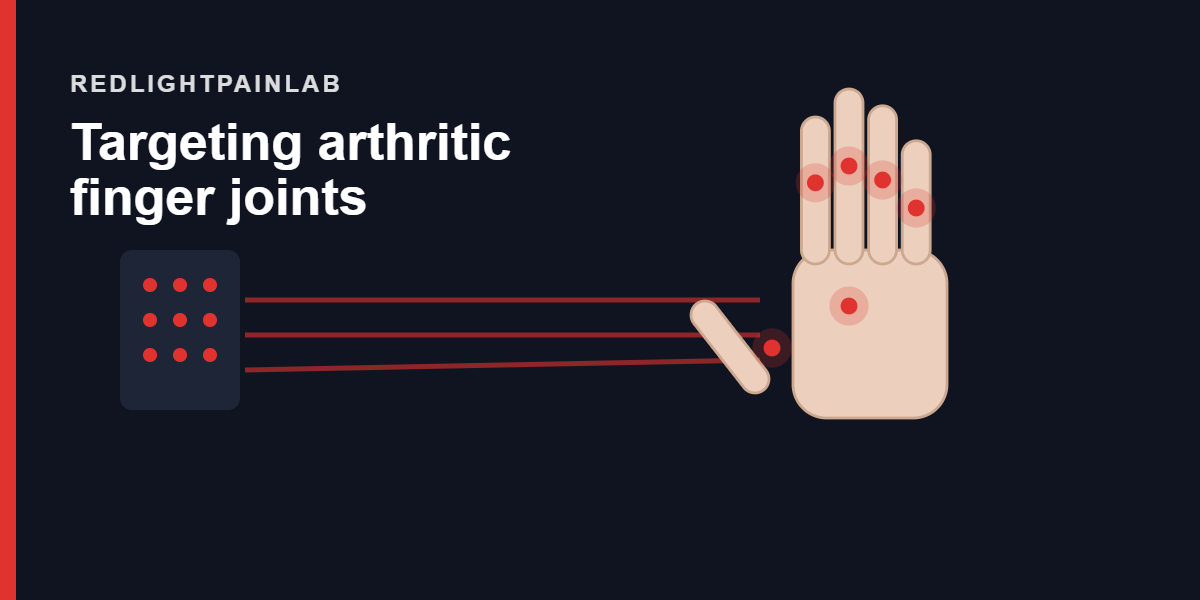
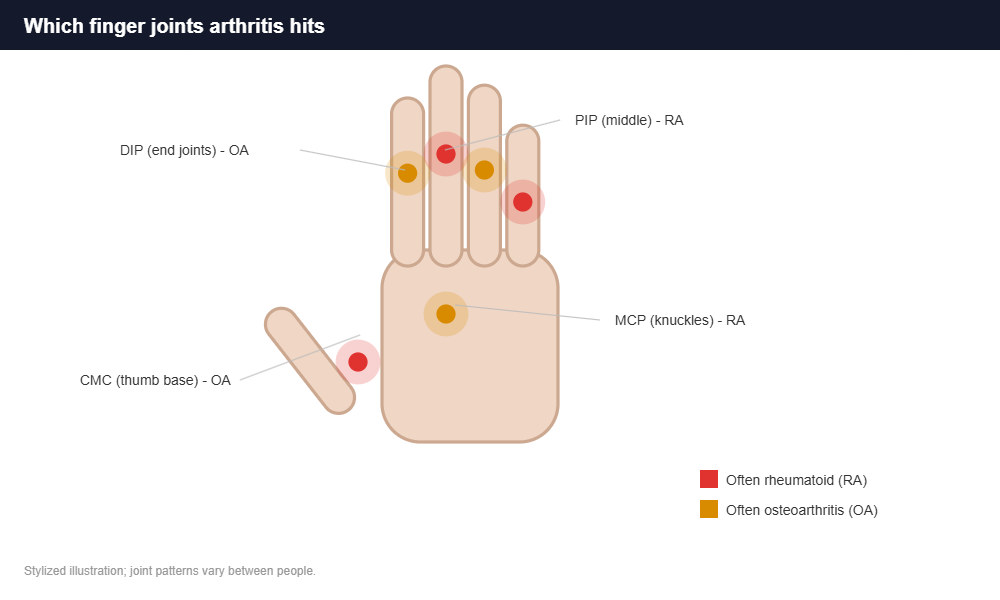
Knowing which one you have sets the expectation. Rheumatoid arthritis is an autoimmune disease that inflames the joint lining, classically in the knuckles (MCP joints) and the middle finger joints (PIP joints), with swelling and long morning stiffness. Hand osteoarthritis is wear-and-tear, more often in the end finger joints (DIP joints) and the base of the thumb (the CMC joint), with bony knobs and stiffness after use. Red light therapy targets inflammation, which is likely why it did more for rheumatoid hands than for osteoarthritic ones.
How does it ease hand arthritis pain?
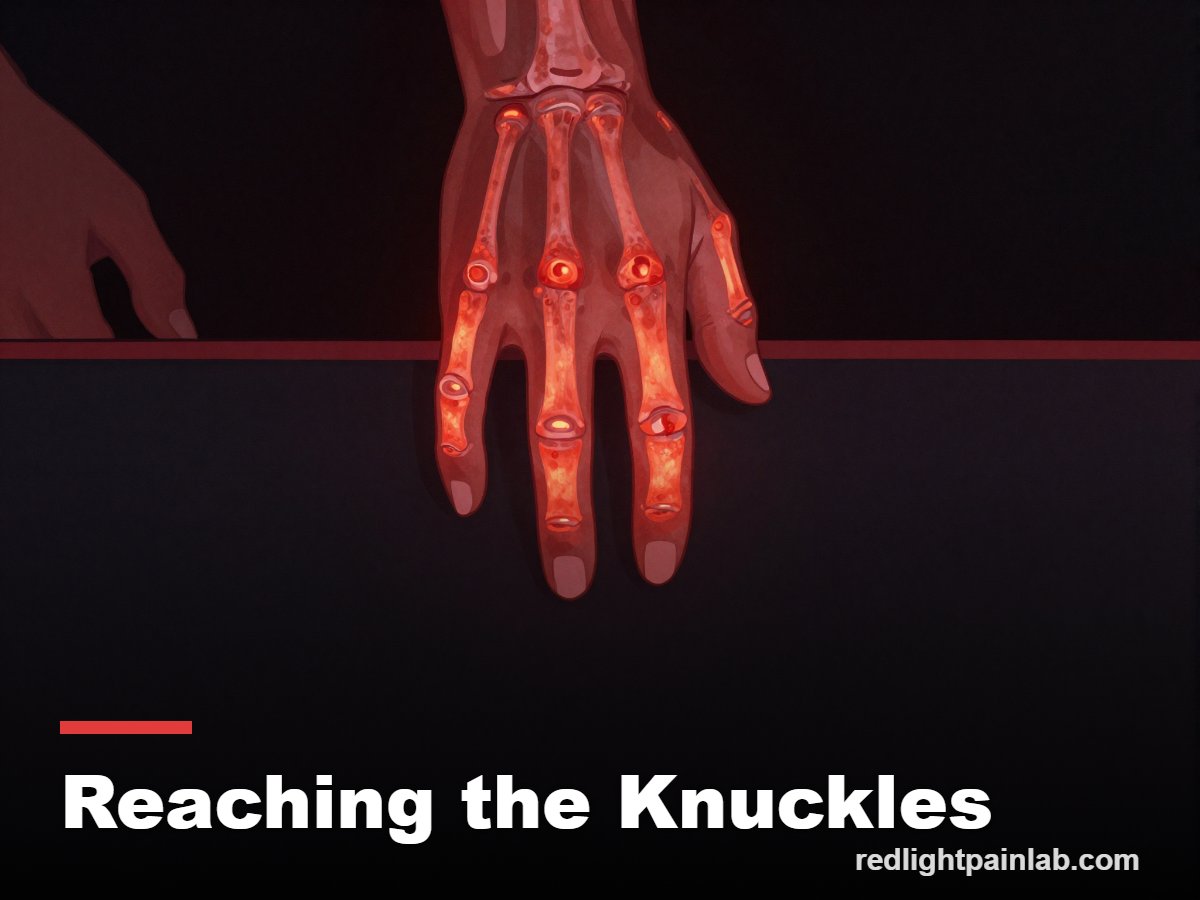
It works inside your cells. Red and near-infrared light is absorbed by an enzyme in the mitochondria called cytochrome c oxidase, which releases nitric oxide, restarts the cell’s energy chain, and raises ATP, the molecule that fuels repair (Hamblin, 2018). In an inflamed finger joint, that can mean less swelling, better local blood flow, and lower pain. It does not stop the disease or rebuild cartilage, so treat it as symptom relief.
What does the evidence show?
Here is the hand-specific breakdown.
Which finger joints does it target?
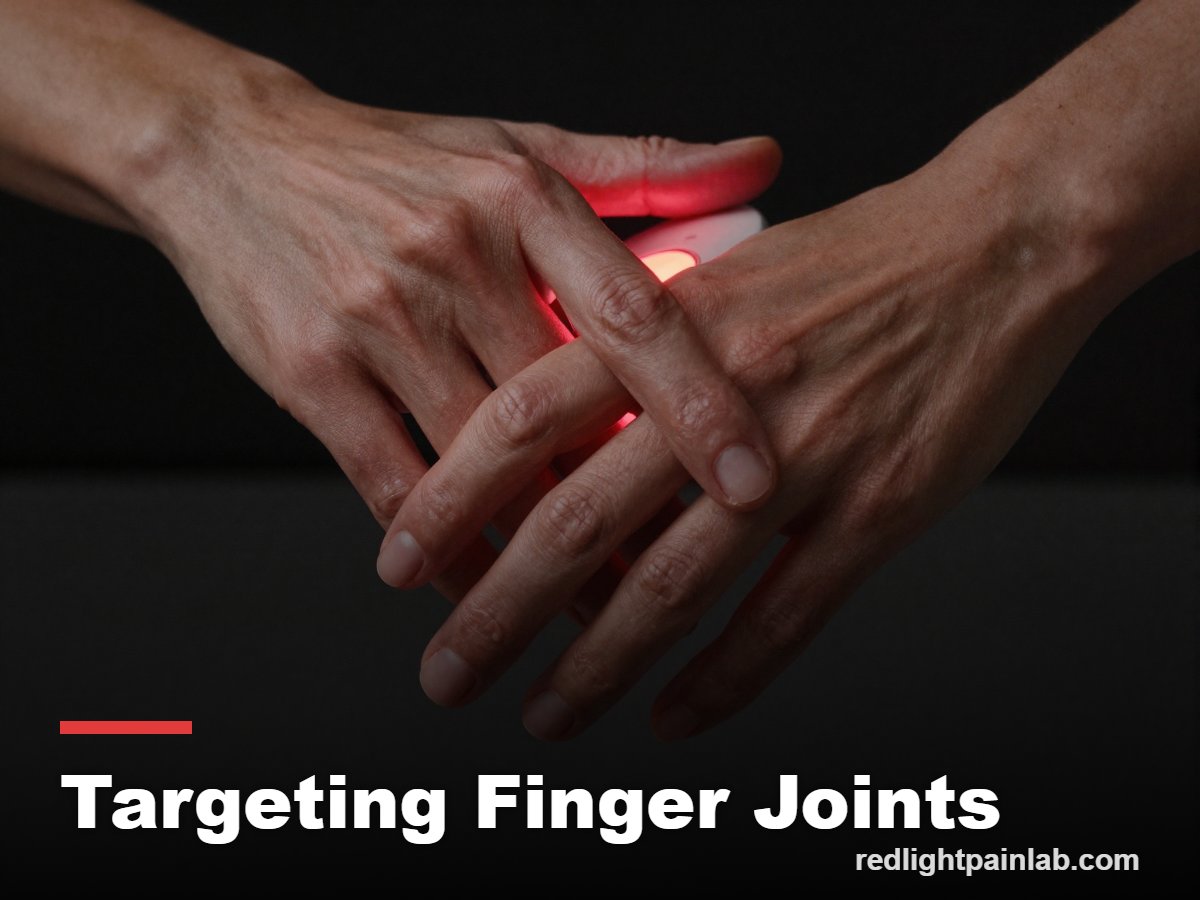
Aim at the joints that actually hurt. Rheumatoid arthritis tends to hit the knuckles (MCP joints) and the middle finger joints (PIP joints); hand osteoarthritis tends to hit the end joints (DIP joints) and the base of the thumb (CMC joint). The good news for the hands is that all of these joints are shallow, so you do not need deep penetration to reach them, unlike the knee or hip.
What wavelength is best for the hands?
For finger joints, both red light (around 660 nm) and near-infrared (around 800 to 850 nm) work, because the joints sit close to the surface. A device that offers both bands covers your options, and a smaller panel or a flexible wrap that wraps around the fingers gives the most even coverage. For deeper joints elsewhere in the body you would lean harder on near-infrared, but the hands are forgiving.
How to use red light therapy on your hands

The hand studies kept it simple: light on the joints, short sessions, repeated for several weeks. A practical routine:
- Choose a device with red and near-infrared light, ideally a small panel or a hand wrap.
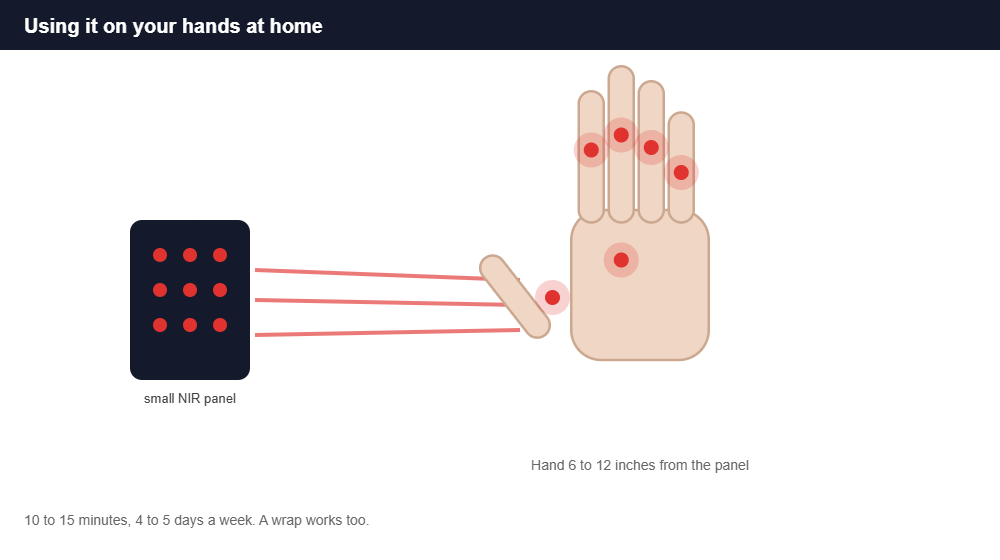
- Position your hand 6 to 12 inches from a panel, or wrap the device around the fingers.
- Treat 10 to 15 minutes per session, about 4 to 5 days a week.
- Cover both the back and the palm side of the joints if you can.
- Keep up gentle hand exercises and any medication your doctor prescribes.
- Give it 4 to 6 weeks, then reassess. Wear eye protection if you use a bright panel.
Is it safe for arthritic hands?
The safety record is strong. The hand trials, including the Cochrane rheumatoid arthritis review, reported no side effects. The occasional issue is minor warmth or brief redness from sitting too close. Check with your doctor first if you are pregnant, take a medication that makes you sensitive to light, are in an active flare, or have a condition affecting light sensitivity. If you have rheumatoid arthritis, keep taking the disease-modifying medication your rheumatologist prescribes; light therapy is an add-on, not a substitute.
What does it cost?
Expect to pay out of pocket, since insurance in the US rarely covers red light therapy as a general wellness tool. For the hands the upside is that you do not need a large, powerful panel: a small panel or a hand wrap is usually enough and costs less than the big full-body units, which makes hand arthritis one of the more affordable uses to try at home.
Choosing a device for hand arthritis
For the hands, prioritize a device with both red and near-infrared light and a form factor that fits a hand, a small panel or a flexible wrap, with third-party-tested specs rather than marketing claims. You do not need maximum depth here, so do not overpay for a huge panel. We rank options on these factors in our best red light therapy panels for pain. As an independent site, our current top pick for overall depth and value is the RLT Home TotalSpectrum. For related joints and the wider picture, see our guides to arthritis pain, osteoarthritis, and knee pain.
Real Red Light Therapy Experiences on Reddit
Real, unpaid discussions about red light therapy for hand and finger arthritis on Reddit. Anecdotal context, not proof. Links go to the original threads.
r/redlighttherapy
Red light for arthritis in hand
People with hand arthritis discuss devices and dosing for finger and knuckle joints.
r/Osteoarthritis
Newly diagnosed with moderate OA in hands at 48
A hand-OA patient asks what has helped, with red light therapy among the options raised.
r/redlighttherapy
Tried red light therapy for my RA, sharing my experience
A rheumatoid arthritis patient documents results, much of it focused on the hands.
Disclaimer: The Reddit posts above are third-party personal discussions shared by individual users. They are anecdotal, not medical evidence. Results vary and are not verified or endorsed by RedLightPainLab. Always consult a qualified professional before starting red light therapy.
Frequently asked questions
Does red light therapy work for arthritis in the hands?
For rheumatoid arthritis of the hands, yes, modestly and short-term: a Cochrane review found less pain and morning stiffness and a small gain in finger flexibility. For hand osteoarthritis the evidence is weaker, with one trial showing no clear benefit. Use it alongside standard care.
Does it help arthritis in the fingers and knuckles?
Yes, those are exactly the joints the hand studies treated. Aim the light at the sore knuckles and finger joints. Because they are shallow, both red and near-infrared light reach them easily.
How long until it helps hand arthritis?
Give it a few weeks. Try 10 to 15 minutes per session, 4 to 5 days a week, for 4 to 6 weeks, then reassess. For rheumatoid arthritis the benefit is mainly short-term, so consistency matters.
What device is best for the hands?
A small panel or a flexible hand wrap with both red and near-infrared light. You do not need a large, deep-penetrating unit for finger joints, so a compact device is usually enough.
Can it cure hand arthritis or rebuild cartilage?
No. The evidence is for easing pain and stiffness, not for curing arthritis or rebuilding cartilage. Treat it as symptom relief on top of exercise, medication, and medical care.
Is red light therapy FDA approved for hand arthritis?
Red light therapy panels are FDA registered, not FDA cleared or approved. Registration means the device is listed as a general wellness product; it is paperwork, not proof it treats arthritis. Some medical laser units carry 510(k) clearance, but consumer panels do not.
References
- Brosseau L, et al. Low level laser therapy (Classes I, II and III) for treating rheumatoid arthritis. Cochrane Database of Systematic Reviews. 2005;(4):CD002049. Cochrane
- Brosseau L, et al. Randomized controlled trial on low level laser therapy (LLLT) in the treatment of osteoarthritis (OA) of the hand. Lasers in Surgery and Medicine. 2005. PubMed
- Hamblin MR. Mechanisms and mitochondrial redox signaling in photobiomodulation. Photochemistry and Photobiology. 2018;94(2):199-212. PMC
Medical disclaimer: This article is for informational purposes only and is not medical advice. Always consult a qualified healthcare professional before starting any new treatment, including red light therapy. If you have rheumatoid arthritis, do not stop prescribed medication.
Affiliate disclosure: We earn a small commission when you buy through our links, at no extra cost to you. This funds our independent research. Rankings are never influenced by commission rates.