
By the RedLightPainLab Research Team · Published June 9, 2026 · Last updated June 9, 2026
Affiliate disclosure: Some links below are affiliate links. We may earn a commission at no extra cost to you. We are independent; rankings are based on our methodology and are never paid for.
Red light therapy, also called photobiomodulation or low-level laser therapy (LLLT), can ease arthritis pain, and the benefit depends on the type of arthritis. For rheumatoid arthritis, a Cochrane review found short-term relief of pain and morning stiffness. For osteoarthritis, especially in the knee, it modestly reduces pain. It works best alongside exercise and standard care, not instead of them.
The short version
- Arthritis is not one disease. The two big types, osteoarthritis and rheumatoid arthritis, respond differently.
- For rheumatoid arthritis, a Cochrane review found short-term cuts in pain and morning stiffness, with no side effects.
- For knee osteoarthritis, two meta-analyses found a modest pain reduction versus placebo.
- Hand osteoarthritis is the weakest case; a trial found no real benefit over a sham.
- It eases symptoms and is low risk, but it does not stop disease progression or rebuild cartilage.
Does red light therapy work for arthritis pain?
Yes, modestly, and the strength of the evidence depends on the type. For rheumatoid arthritis, a Cochrane review of 5 randomized placebo-controlled trials (222 people) found that low-level laser therapy reduced pain by about 1.1 points on a 10-point scale and cut morning stiffness by roughly 27 minutes, with no reported side effects. The benefit was short-term, and most studies treated the hands (Brosseau et al., Cochrane, 2005).
For osteoarthritis, the knee has the best data. A 2019 meta-analysis of 22 trials (1,063 people) found light therapy beat a placebo for knee OA pain (Stausholm et al., 2019), and a 2024 review agreed on a moderate pain reduction but rated the certainty very low and called it a complement to exercise (Physical Therapy, 2024). Across the board the effect is real but modest, and bigger when paired with movement and standard care.
Osteoarthritis vs rheumatoid arthritis: why the difference matters
They are different diseases, so set expectations accordingly. Osteoarthritis is wear-and-tear damage to cartilage, usually in one or a few joints like the knee or hands. Rheumatoid arthritis is an autoimmune disease where the immune system attacks the joint lining, often in the small joints of the hands and feet, with inflammation, swelling, and morning stiffness. Light therapy targets inflammation and cellular energy, which is why it showed a clear short-term effect on RA stiffness and pain, while for OA it mainly takes the edge off pain in the treated joint.
How does it ease arthritis pain?
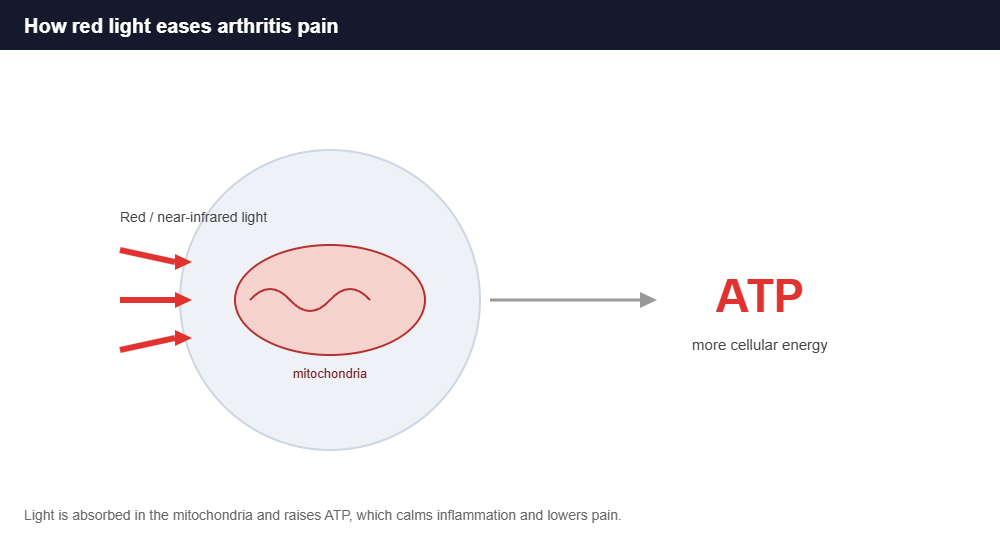
It works at the level of your cells. Red and near-infrared light is absorbed by an enzyme in the mitochondria called cytochrome c oxidase, which releases nitric oxide, restarts the cell’s energy chain, and raises ATP, the molecule that fuels repair (Hamblin, 2018). In an inflamed joint, that can mean less inflammation, better local blood flow, and lower pain signaling. What it does not do is stop the underlying disease or rebuild lost cartilage, so think symptom relief, not a cure.
What does the evidence show by arthritis type?
Here is the honest breakdown across the three best-studied scenarios.
| Arthritis type | Best available evidence | Finding | Certainty |
|---|---|---|---|
| Rheumatoid arthritis | Cochrane review, 5 RCTs, 222 people (2005) | Pain down ~1.1 points; morning stiffness down ~27 min; no side effects; short-term | Low (short-term) |
| Knee osteoarthritis | Meta-analyses: 22 RCTs / 1,063 (2019) and 10 studies / 542 (2024) | Modest pain and disability reduction vs placebo; best with exercise | Moderate effect, low to very low certainty |
| Hand osteoarthritis | RCT, 88 people, 6 weeks (2005) | No significant pain, stiffness, or function benefit vs placebo | Low / mixed |
Sources: Cochrane 2005 (RA), Stausholm 2019, Physical Therapy 2024, Brosseau 2005 (hand OA).
What about arthritis in the hands and fingers?
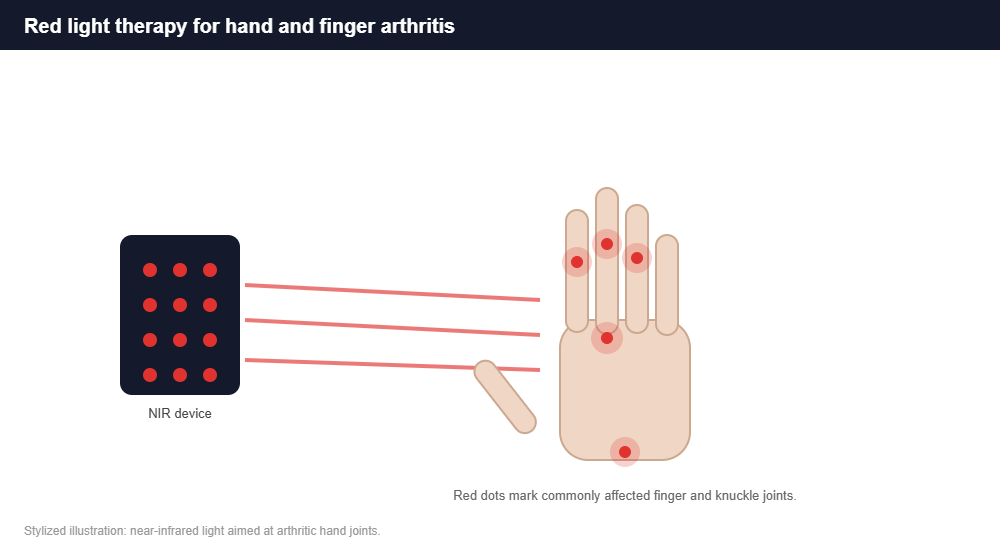
The hands are where red light therapy has its most direct arthritis evidence, because most of the rheumatoid arthritis trials treated the hands. Alongside the pain and morning-stiffness gains, the Cochrane review found that low-level laser therapy improved tip-to-palm flexibility by about 1.3 cm, a small but real hand-function gain (Cochrane, 2005). For hand osteoarthritis the picture is weaker, with a randomized trial finding no clear benefit over a sham. Because finger joints sit close to the surface, both red and near-infrared light can reach them, and a small panel or a wrap that cups the hand makes even coverage easier.
What wavelength is best for arthritis, and why does depth matter?
Use a device with near-infrared light, because most arthritic joints sit below the surface and red light alone does not reach them well. Within the optical window of roughly 600 to 1100 nm, longer near-infrared wavelengths travel deeper. Red light near 660 nm mostly treats skin and shallow tissue, while near-infrared from about 800 to 850 nm and up reaches deeper joint structures. For small, near-surface joints like the fingers, red and shorter near-infrared can reach more easily; for the knee or hip, you want deeper near-infrared.
One honest caveat: most arthritis trials used roughly 785 to 905 nm. The case for 1064 nm reaching the deepest joints is good physics, but high-quality 1064 nm arthritis trials are still limited, so treat deeper as a reasonable rationale, not proven fact. Our wavelength and depth breakdown goes further.
LED panels vs laser: clinics often use laser devices, which focus energy on a small spot and penetrate well, while home units use LEDs that cover a wider area at lower intensity. For arthritis at home, an LED panel with genuine near-infrared is the practical choice; lasers can go deeper per spot but are usually a clinic tool. What matters most is real near-infrared output reaching the joint, not the LED-versus-laser label by itself.
How to use red light therapy for arthritis at home
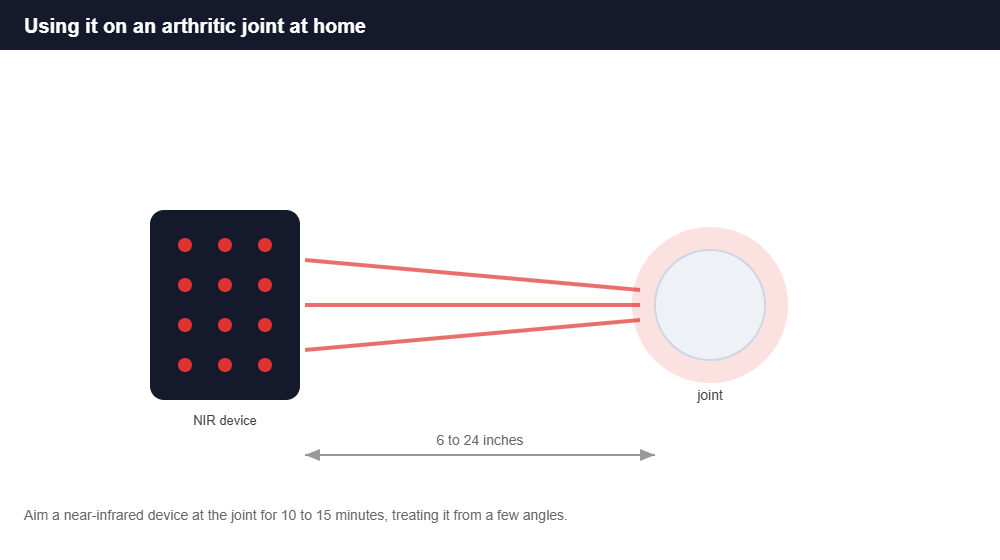
The protocols that worked in studies were simple: aim the light at the affected joint, keep sessions short, and repeat them for several weeks. A practical starting routine:
- Pick a device with near-infrared (around 800 to 850 nm or longer) for deeper joints; red plus near-infrared is fine for fingers.
- Position it 6 to 24 inches from the joint, with bare skin exposed.
- Treat 10 to 15 minutes per joint, about 4 to 5 days a week.
- For larger joints, treat from a few angles (front, sides, and back).
- Keep up the exercise, movement, and any medication your doctor prescribes.
- Give it 4 to 8 weeks, then reassess. Wear the eye protection.
Is it safe for arthritis? Who should skip it?
The safety record is strong. The arthritis trials, including the Cochrane review of rheumatoid arthritis, reported no side effects. The occasional issue is minor: eye strain without goggles, mild warmth, or brief redness from sitting too close. Wear the eye protection that ships with the device, follow the recommended distance and time, and check with your doctor first if you are pregnant, take a medication that makes you sensitive to light, have an active flare, or have a condition affecting light sensitivity. If you have rheumatoid arthritis, keep taking the disease-modifying medication your rheumatologist prescribes; light therapy is an add-on, not a substitute.
How does it compare with other arthritis treatments?
Treat it as one tool, not a replacement. For osteoarthritis the backbone is exercise, weight management, and physical therapy, with NSAIDs or injections for flares. For rheumatoid arthritis, disease-modifying drugs (DMARDs) are essential to control the disease itself. Red light therapy is drug-free and low risk, which makes it a reasonable add-on for symptom relief, especially if you want to lean on pain medication a little less, but it does not slow either disease.
What does it cost?
Expect to pay out of pocket. Insurance in the US rarely covers red light therapy for arthritis, since it is treated as a general wellness tool. You are choosing between paying a clinic per visit across a multi-week course, or buying a home device once and using it as often as you like. Home units tend to be less powerful than clinic machines, so they can take longer to work, which is the trade-off for the lower running cost.
Choosing a device for arthritis
For most arthritic joints, look for real near-infrared output at enough power to reach the joint from a comfortable distance, with third-party-tested specs rather than marketing numbers. A wrap or pad can help with hands and knees. We rank options on exactly these factors in our top 5 devices for pain. As an independent site, our current top pick for depth and value is the RLT Home TotalSpectrum, which carries near-infrared and deep near-infrared bands suited to joints. For more on specific joints, see our guides to osteoarthritis and knee pain.
Frequently asked questions
Does red light therapy work for arthritis pain?
Modestly, and it depends on the type. A Cochrane review found short-term pain and morning stiffness relief for rheumatoid arthritis, and meta-analyses found a modest pain reduction for knee osteoarthritis. Hand osteoarthritis is the weakest case. Use it alongside exercise and standard care.
Is it better for rheumatoid arthritis or osteoarthritis?
Both have support, but for different reasons. Rheumatoid arthritis showed clear short-term cuts in pain and morning stiffness in a Cochrane review, while knee osteoarthritis showed a modest pain reduction across two meta-analyses. Neither slows the disease itself.
How long until it helps arthritis pain?
Give it a few weeks. Benefits build over a course of sessions. A fair trial is 10 to 15 minutes per joint, 4 to 5 days a week, for 4 to 8 weeks, then reassess. For rheumatoid arthritis the benefit is mainly short-term, so consistency matters.
Can it cure arthritis or rebuild cartilage?
No. The evidence is for easing pain and stiffness, not for curing arthritis, slowing the disease, or rebuilding cartilage. Treat it as symptom relief on top of exercise, medication, and medical care.
What wavelength is best for arthritis?
Near-infrared for deeper joints like the knee or hip, because they sit below the surface; red plus near-infrared works for small surface joints like the fingers. Most successful trials used roughly 785 to 905 nm.
Is red light therapy FDA approved for arthritis?
Red light therapy panels are FDA registered, not FDA cleared or approved. Registration means the device is listed with the FDA as a general wellness product; it is paperwork, not proof it treats arthritis. Some medical laser units carry 510(k) clearance, but consumer panels do not.
References
- Brosseau L, et al. Low level laser therapy (Classes I, II and III) for treating rheumatoid arthritis. Cochrane Database of Systematic Reviews. 2005;(4):CD002049. Cochrane
- Stausholm MB, et al. Efficacy of low-level laser therapy on pain and disability in knee osteoarthritis. BMJ Open. 2019;9(10):e031142. PubMed
- Effectiveness of photobiomodulation in reducing pain and disability in patients with knee osteoarthritis. Physical Therapy. 2024;104(8):pzae073. Journal
- Brosseau L, et al. Randomized controlled trial on low level laser therapy (LLLT) in the treatment of osteoarthritis (OA) of the hand. Lasers in Surgery and Medicine. 2005. PubMed
- Hamblin MR. Mechanisms and mitochondrial redox signaling in photobiomodulation. Photochemistry and Photobiology. 2018;94(2):199-212. PMC
Medical disclaimer: This article is for informational purposes only and is not medical advice. Always consult a qualified healthcare professional before starting any new treatment, including red light therapy. If you have rheumatoid arthritis, do not stop prescribed medication.
Affiliate disclosure: We earn a small commission when you buy through our links, at no extra cost to you. This funds our independent research. Rankings are based on our scoring methodology and are never influenced by commission rates.